Thursday, June 02, 2011

Breathe

I haven't written in a few weeks; just been really busy, and a lot going on with decisions we have to make for the future. I can't really say a lot now, but I needed to write, just to get some things out there.

Too often, it's not until I get into stressful situations that I realize how lazy I have been in my relationship with God. My journey over the last 10 years has taken me to a place where I have a lot of questions these days, where I wrestle with things rather than just find an answer.

Why is this happening? What is God doing? What should I be doing? How do I make this decision? ... these have been running through my mind for the last month.

I'm trying to focus on the "What is God doing" question, specifically in the present. Not wondering about the decision I need to make next week, but what I need to do today to move me toward that.

What do I need to talk with my wife about at this point? How can I best love her and value her and learn from her, with where we are today? How can I best love and teach my kids today, especially when I'm stressed and short-tempered?

How can I breathe, relax, let go, and be myself; trusting God for today?

Simply pausing long enough to write this out helps. As I often do when stressed (and now is one of those times--big time), I ponder the good: an amazing family that blesses me every minute of every day, a job I love going to (even though it's short-term, I love it today!), baseball, friends, a great network of people praying for us and supporting us, weddings (I had one a couple weeks ago, and another this weekend), sports to watch (Go Mavs!), books to read (Dallas Willard's The Divine Conspiracy), good TV (watching Rescue Me on Netflix).

Next week may be stressful; heck, tomorrow will probably be. But today I'm enjoying all the great things in life, and trying to give tomorrow to God.

Tuesday, May 17, 2011

another question about hell


From Brian McLaren's A New Kind of Christian:

Religious determinists have offered us another determinism we could call the “soul-sort” universe: everyone will be sorted into either the destruction/damnation or the redemption/salvation bin. Everyone is determined to end up in one or the other. That sounds good if you’re one of the chosen few, but, then again, how could good and generous people rest in peace or celebrate in bliss when they know the majority of their ancestors, friends, family members, and descendants are experiencing eternal conscious torment in hell? (p. 195)

This is a question I have really begun to wrestle with. There is no easy answer, and it’s not a debate that’s going to be settled anytime soon. But I think it is an important conversation to have—to think, share ideas, listen, ponder, read, study, wonder…It’s one of those issues that isn’t as black and white as we may want it to be.

Brian asks an interesting question in a recent blog post, responding to a question about whether or not Osama bin Laden is in hell: “Do we fear that God will be excessively merciful or excessively harsh?”

Thoughts, anyone?

Saturday, May 14, 2011

Brian McLaren on church

From A New Kind of Christianity:


The church, then, in Paul’s mind, must be above all a school of love. If it’s not that, it’s nothing,. Its goal is not simply to pump knowledge into people, but to train them in the “way of love,” so they may do the “work of the Lord,” empowered by the Holy Spirit, as the embodiment of Christ. Perhaps school isn’t the best metaphor, though, unless we think of a karate school or a dance school or a language school—not simply a community where you learn or learn about, but where you learn to. (p.170)


Too often we think of church as a place to impart information, rather than a group of people who walk through life together. The types of schools Brian gave as examples are schools that are more about doing something, as well as learning something. The knowledge we often gain in church does little more than make us feel better about ourselves, or more sure of our position (and as a result, more critical of others).


Church should be a group of people who “do life together.” People committed to looking beyond themselves to the community and world around them, striving to establish God's kingdom and helping make the lives of others a little better.

Friday, May 13, 2011

common ground

With all the differences within the Church, what is the one common mission or message?


“To form Christ-like people, people of Christ-like love.” (A New Kind of Christian, p. 164)


Yesterday I posted a passage (which Blogger lost, and I don't have the book with the quote anymore) about diversity in churches and denominations, and how that can be a good thing. So if we celebrate diversity instead of judging or criticizing those who are different, what do we focus on? What do we seek as common ground? It’s easy to focus on the differences, but what do we have in common?


Instead of making sure that others have the right theology; what if we simply love them as Christ loves them, and walk by their side as they go through life. What if we allow the Holy Spirit to teach and grow and correct?


I’m not saying we never teach or disagree or offer correction to someone else. But we should do it in a spirit of humility, not arrogance; remembering that there are times when we may not be right, or have the only valid perspective. Our focus should be to love one another, and let God do the molding and shaping. I notice that anytime I get too focused on what I think God wants to do in someone else’s life, I lose sight of what God may be doing in my life.

Wednesday, May 11, 2011

Gospel of the Kingdom (more from Brian McLaren)

In A New Kind of Christian, Brian McLaren describes a conversation with a well-known Evangelical theologian:


(he) upset years of theological certainty with one provocative statement: “Most Evangelicals haven’t got the foggiest notion of what the gospel really is.” He then asked me how I would define the gospel, and I answered as any good Romans Protestant would, quoting Romans. He followed up with this simple but annoying rhetorical question: “You’re quoting Paul. Shouldn’t you let Jesus define the gospel?” When I gave him a quizzical look, he asked, “What was the gospel according to Jesus?” A little humiliated, I mumbled something akin to “You tell me,” and he replied, “For Jesus, the gospel was very clear: The Kingdom of God is at hand. That’s the gospel according to Jesus. Right?” I again mumbled something, maybe “I guess so.” Seeing my lack of conviction, he added, “Shouldn’t you read Paul in light of Jesus, instead of reading Jesus in light of Paul?

--p. 137-138

I think the theologian Brian refers to is Dallas Willard. I heard Dallas talk about this several years ago, and was really impacted by his ideas about the Kingdom.

I think many of us have elevated the writings attributed to Paul above the words of Jesus in the NT. Paul is more black and white, easier to understand and apply. But Jesus’ words, while not always as clear and straightforward, reveal first-hand the heart of God.

Much of the language we use in our modern (and post-modern) Christian culture is not found in the Bible; rather, it is language that comes from our interpretations of the Bible—“personal Lord and Savior,” “make a commitment to Christ,” “the sinner’s prayer.”

In applying such language, we have simplified the Gospel to this: Jesus died on the cross and was resurrected for one purpose—so that those who decide to follow/accept/receive Him will live in heaven forever when they die.

While that is a core belief for Christians, and it is truly good news, it is not necessarily the good news that Jesus proclaimed. We have the idea that the Gospel is about us, about how we can overcome death and go to heaven. But when we look at the words of Jesus, it seems that His priority was his kingdom, and living it out on earth. This is important because it helps us take our focus off ourselves and put it onto others.

Much of our traditional language about the Gospel is focused on our response and reward—we accept Jesus, believe in him, profess him, and obey him—all so that he will be with us, bless us, protect us, and most of all, save us from hell.

But Jesus was most concerned with us learning how to be faithful to him, and living life focused on others. His main message was to love God and serve our neighbor, to do what we can to make the world a better place.

In this I fall terribly short. Especially over the last couple years, as I have tried to keep my family above water financially, finish my MDiv, and look for the next job/ministry/adventure. I have become very self-absorbed. I realize that I do very little to contribute to God’s Kingdom beyond my family and friends.

We are in a period of transition—there will be some new things coming soon for us as a family. I am hopeful that we can have a kind of fresh start, and commit as a family to be more involved in helping to live out God’s Kingdom in our community.

Friday, May 06, 2011

random thoughts


Just some random thoughts on a Friday night. It was a good week; worked at Mountain View most of the week--fun in PE class (whiffle ball), English, Chemistry.

Had some good and bad baseball this week. A fun, come from behind win by the home team in a local varsity game tonight; and a 15-1 private school blowout yesterday. The language in baseball is pretty rough, even in high school. At least at the private schools, they preface the profanity with prayer; ie. "Jesus Christ, I didn't hit that worth sh*t!"

Tonight I was standing near the plate between innings, looking up at the sky--it was beautiful. We had rain earlier, now it was clearing up, the sun was going down, and the sky was filled with scattered clouds and rays of sunshine breaking through. Just then, three old airplanes flew over the field (there is an old air-field nearby). Watching those planes fly across the sky, with the clouds and the colors of the sunset behind, was breathtaking.

I stood there thinking how great my life is. Even in stressful times, I am blessed with a family that fills me with joy, a home, great friends, and baseball. I love baseball season. I love umpiring. 2 games tomorrow; better get to bed.

Thursday, May 05, 2011

Seeing through the Bible

more from A New Kind of Christian by Brian McLaren:

…seeing Christ as the hinge of the biblical story, the spine or backbone of the narrative, the climax and focal point toward which the Old Testament points and ascends and the peak from which the vigor and vitality of the New Testament flow. This is how Jesus can be seen, for Christians, as the supreme and ultimate revelation of God, with the Old and New Testaments pointing to him like dual spotlights…


Don’t simply look at the Bible, I am suggesting; look through the Bible to look at Jesus, and you will see the character of God shining radiant and full. (p. 118)


In his gospel, John identifies Jesus as the Word. Yet today, when we refer to the Word, we are almost always talking about the Bible. Is this wise? Is it accurate? Do we run the risk of worshiping the Bible instead of Jesus? The Bible is not the goal—Jesus is. The Bible is an amazing collection of writings that all tell the story of God and His relationship with His people. It is a great tool or resource to help us learn about and connect with God; and we believe that God communicates through it; but it is not God.


To live according to the Word…I want this to mean that I live in intimate relationship with Jesus. Reading the Bible, studying it, praying it, living in it--helps me in my relationship with Jesus; not by telling me what and what not to do, but by revealing the heart of God, seen through his interactions with his people over thousands of years, and embodied in the life and teachings of His son, Jesus.


The Bible helps me better see God’s heart, God’s desires for my life, God’s hopes for the world we live in. The Bible comforts me when I am hurting, encourages me to be the man God wants me to be, challenges me when I need it, and most of all, shows me the amazing, endless, perfect love of the God behind the words and stories.

Thursday, April 28, 2011

retreat


Yesterday I got to spend some time on a pastors' retreat with a group of guys from Christ the King Community Church in Washington. CTK has done a great job of creating a multi-site church where several local congregations are connected to the church/network for resources, leadership, etc.

It was great to be a part of the meeting--I got to hear much of their history, how things are going, and where they are headed. CTK currently has 21 congregations in Washington, 9 in other states (from Idaho to Florida to Texas, and several other states), 2 in Canada, and multiple groups in India, Kenya, South Africa, Philippines, and Pakistan.

It was beautiful to see the openness of these pastors sharing some of their stories (the good, the bad, and the ugly); being real and honest, in what is probably the only place they can do that. I was impressed with these guys from different backgrounds, different personalities, different life experiences, all working together to impact their communities for Christ.

Dave Browning, who leads CTK, has written some great books--I read Deliberate Simplicity last year and and recommend it to all pastors and church leaders.

In the midst of a fun but somewhat stressful week, it was great to spend the afternoon with this group, being both challenged and encouraged about life, ministry, church, and family.

Tuesday, April 26, 2011

new friends


Today was a really great day. I met some new people, and spent several hours in really good conversation. I'm on spring break, and the pace of life has slowed down a bit. I am reminded that when life gets so busy and rushed, we miss opportunities to slow down and really listen to someone.

Today I met several new people--two of whom are newlyweds (always fun to be around them, they are so full of joy), and spent several hours talking with a new friend; a guy who took time out of his busy day to spend with me. It's encouraging when you talk and realize that others have similar experiences, have been through similar struggles, and are experiencing similar joys and challenges.

That's when I experience God's Kingdom, people living life together and encouraging one another. I love seeing how God works in people's lives and blesses them. And I feel God's blessing when I get to be a part of those conversations and experiences.

Saturday, April 23, 2011

dark day

Yesterday was a dark day. Yes, it was Good Friday, the day we remember Jesus' crucifixion, in anticipation of His resurrection.

But on a more temporal level, it was a dark day because Jim Larranaga resigned as coach of George Mason's basketball team to take the head coaching job at the University of Miami.

Coach L was at Mason for 14 years and did amazing things for the program, including leading them to the Final Four in the greatest run in tournament history, culminating with an overtime victory over #1 UConn.

I've had season tickets with several of my best friends for the past 9 years. Basketball season is my favorite time of the year. At the end of each season, we go to Richmond for the conference tournament, where we stay in a hotel and act like we're in college again for the weekend. It is something I look forward to all year long.

Coach L leaving hit me really hard yesterday; I will grieve this for a while--it feels like losing a close friend. We had one of the very best coaches in the country.

But it is a good reminder that life is full of changes. So I'll grieve, but also look ahead, and I'll always root for Mason.

Friday, April 22, 2011

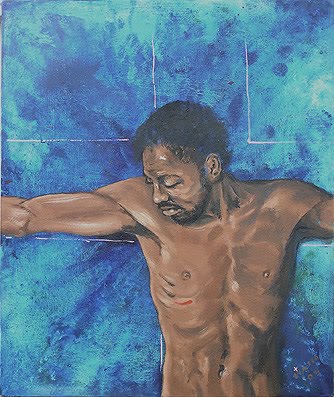
Images for Good Friday

Some images for reflection on Good Friday. We used these in worship at Convergence a few years ago. (I'm sorry I don't have title and artist info.)


Jesus like God, or God like Jesus

More from A New Kind of Christianity by Brian McLaren:

Elton Trueblood: “The historic Christian doctrine of the divinity of Christ does not simply mean that Jesus is like God. It is far more radical than that. It means that God is like Jesus.”

In other words, the doctrines of the incarnation and deity of Christ are meant to tell us that we cannot start with a predetermined, set-in-stone idea of God derived from the rest of the Bible and then extend that to Jesus. Jesus is not intended merely to fit into those predetermined categories; he is intended instead to explode them, transform them, alter them forever, and bring us to a new evolutionary level in our understanding of God. An old definition of God does not define Jesus—the experience of God in Jesus requires a brand-new definition or understanding of God. (p.114)

This was really interesting to me. I realized that I have always seen Jesus as somehow less than or smaller than God. I've had this idea of God that is big and wide and incomprehensible, but my understanding of Jesus was simpler, more finite.

Thinking this through over the last few days has started to turn that around in my mind…Jesus, in a way, seems even more complete than God the Father, in the sense that he is something new, or more—he is also human. He takes physical form. He embodies everything God is, not just on a spiritual level, but also on a physical level.

Jesus is God, and He contains everything that is God. What is God like? God is like Jesus. All the things that Jesus said. All the things that he did. That’s God.

Now, I know all of this is perception--God is not "less than" anything. And my growing understanding is still very far from truly comprehending God. But my perception of God/Jesus is very important in defining how I relate to God, Jesus, and everyone else. Lately I'm thinking that the Bible is not so much about telling me how to live my life, as it is about helping me to know God better, more personally, more intimately. And that's what Jesus helps me do--as I read of his life in the Bible, as I pray, as I strive to live out his love for God and for people.


Thursday, April 21, 2011

Maundy Thursday Prayer


A Prayer for Maundy Thursday:

On this holy night we dine together as the body of Christ, and at the table commit ourselves to love and serve one another. On this holy night, then, let us pray for the church and all humankind.

God our provider, you feed us with the bread of life and lift for us the cup of salvation, on this night Jesus gave us this holy feast:

may all who gather at your table receive a foretaste of the eternal banquet.

God of love
grant our prayer.

Servant God, on this night Jesus washed his disciples' feet: may we follow this example of love and service.

God of love
grant our prayer.

God of compassion, on this night Jesus prayed for those who would believe through the message of the disciples: may those who gathered on this day to renew their ordination vows so live what they proclaim that all may come to know your saving love.

God of love
grant our prayer.

God of renewal, on this day oil was consecrated for use in baptism and healing: we pray for all who will be anointed with these holy oils, for the sick, and for those preparing for baptism.

God of love
grant our prayer.

God our companion, we pray for those unable to eat at the Lord's Table or at any other table, for those who betray and for those betrayed, and for all innocent victims.

God of love
grant our prayer.

God of hope, remember all those in need, especially those we silently hold before you now ...

God of love
grant our prayer.

Holy God,
you give us this meal of bread and wine
in which we celebrate your great compassion;
grant that we may work with you to fulfil our prayers,
and to love and serve others as Christ has loved us;
this we ask through Jesus Christ our Redeemer,
who is alive with you in the unity of the Holy Spirit,
one God, now and for ever. Amen.

"by Bosco Peters (www.liturgy.co.nz)"

Wednesday, April 20, 2011

using the Bible

Album cover from Arcade Fire's Neon Bible

From Brian McLaren's A New Kind of Christianity:

God’s character is never revealed fully at any single point in the story, nor can it be contained simply in any list of propositions or adjectives derived from the stories of the past. Instead, we can only discern God’s character in a mature way from the vantage point of the end of the story, seen in the light of the story of Jesus. (114)

We do our listeners, our readers, the Bible and ourselves a disservice when we make pronouncements or judgments based on one verse or passage or situation or event. We’ve got to see the big picture—everything leading up to Jesus, and everything following seen in light of Jesus’ life and teaching.

Too often we use the Bible to say what we want it to say. Usually what we want to say is good, but we need to realize and communicate that what we say comes from us, not directly from God. Even our words that come from God’s Word, are filtered through us, and we bring our own stuff to them.

Another mistake we often make is to find several different, unrelated passages, written by different people, which speak to our subject, and put them all together as if they all say the same thing.

A big trend in church is the use of topical sermons. They can be great, but it is really difficult to avoid proof-texting when writing a topical sermon. What often happens is this, we pick a topic, look for Bible passages that address that topic (either directly, or though indirect interpretation); then put together a message based on the 3 or 4 points found.

How often do we hear a message (accompanied by a fill-in-the-blank outline) that uses 7 Scripture passages from 5 different books (and 5 authors) of the Bible, with 3 different Bible translations? I'm not trying to be critical, and truth is, I've done this plenty of times myself.

But when we use Scripture this way, we’re not engaging the Biblical text on its own terms, or seeing it in its own context. It becomes too easy to use Bible verses to support our ideas, rather than letting the Bible form the basis of our ideas. We limit the texts’ ability to say something new or enlightening. This is easy to do when we see the Bible as a constitution, not so much when we see it as an inspired library.

This is one of the beautiful things about using a structure or outline such as a lectionary for preaching. It allows a community to work through the Bible, and challenges the preacher to read and teach the whole Bible, listening to how God speaks through all of it. It also leads to fresh, exciting new insights for both the preacher and the congregation.

Tuesday, April 19, 2011

thoughts from Brian McLaren's A New Kind of Christianity--a posture of wonder


Could it be that God’s Word intends not to give us easy answers and shortcuts to confidence and authority, but rather to reduce us, again and again, to a posture of wonder, humility, rebuke, and smallness in the face of the unknown?

The “us” in the previous sentence raises another question. Do we have a voice in the biblical drama? In other words, does the Bible tell us to shut up and listen, because everything is settled? Or does it invite us to be part of the conversation? (p. 93)


I love this. Digging deeper, seeking to know Jesus through the Bible, doesn’t lead us to theological supremacy, but to spiritual humility. And as Brian illustrates using the story of Job, we do have a voice in the biblical drama. The Bible comes alive as I interact with Jesus—reading, praying, listening, processing, wondering, applying, imagining.


God didn’t make us in God's image so we would shut up, listen, and obey; but so that we could interact with God, relate to God, grow in God.


I think of my children, especially my two youngest. At 3 and 4, they know very little of me. They don’t know all the things I do and think and feel. They don’t know my hopes and dreams for their lives. They don’t understand all the little things I do to teach and train and encourage them to grow into healthy young men. They know very little about all that happens behind the scenes, when they are not watching.


But they know that I love them, with a fierce love that would do anything for them. They know I miss them when I’m gone, and that I am filled with joy when I return to them. They know they can depend on me to protect them and provide for them. They know I am there for them, no matter what.


That’s the love God has for me. There is so much about God that I don’t yet get. I have a lot of questions. But I believe God loves me. I believe God is working behind the scenes in a million ways that I don’t get. I believe that God is with me and for me the same way I am with and for my kids (times a million). Wow.

Monday, April 18, 2011

reading through A New Kind of Christianity--clarity and mystery


(not sure what I'm trying to say with this image, but it is rather thought-provoking)


From A New Kind of Christianity by Brian McLaren:

Does the Bible alone provide enough clarity to resolve all questions, as a good constitution should? No. We have no reason to believe it was ever meant to do that, as much as we’ve tried to force it to do so. From all sides it becomes clear that the Bible, if it is truly inspired by God, wasn’t meant to end conversation and give the final word on controversies. If this were its purpose, it has failed miserably. (This fact must be faced.) But if, instead, it was inspired and intended to stimulate conversation, to keep people thinking and talking and arguing and seeking, across continents and centuries, it has succeeded and is succeeding in a truly remarkable way. (p. 92)

God’s purpose in the Bible isn’t to give us encyclopedia-like answers. It’s not to end the discussion with the simple, final solution. As Brian said, if that were its purpose, it has failed. We have hundreds of Christian denominations in the US, many thousands worldwide. If the Bible is so simple and clear, how can we—the Universal Christian Church—be so divided? There are so many differences, yet each group believes they have the right answers and the correct interpretations.

I wonder if having it all figured out causes us to rely less on God. Following God becomes a list of do's and don’ts (even though we claim it doesn’t)…And if we think we’ve got it figured out, then the only thing left is to do what we think we’re supposed to do.

With everything figured out, there is no mystery. There are no questions. We don’t really even need much from God now, God has served his purpose by giving us the Bible and the correct interpretation and understanding. In that line of thinking, all we need now is God’s strength and discipline. Seems like a pretty shallow relationship to me.

The older I get, the more I realize there is more and more that I don’t have figured out. Things that don’t make sense to me. Questions about the diversity and complexity I see in the Bible, in my fellow man, in myself, in the world we live in. I feel like I am more childlike, not out of anything noble, but because I am often clueless before the God of the universe.

But God does not leave me in my ignorance—rather, God reveals himself in the amazing stories of the Bible, and in the conversations I have with my wife and my friends, and in the laughter of my children, and the joy I find when I teach, or write, or umpire.

Sunday, April 17, 2011

Reading through A New Kind of Christianity


I'm reading A New Kind of Christianity by Brian McLaren. Brian's writing has really spoken to me over the years. I remember the first time I heard of him--it was actually the first time I met him. He was speaking at my first Leland retreat in 2002. I was drawn to his gentle spirit, his passion for God, his honesty.

We have connected several times over the years, and I am always encouraged by his words; both in print and in our conversations. Several years ago we had a conversation at a church where we happened to run into each other. We were talking about something--I don't remember the topic now--but his eyes lit up at something I said and he opened his Bible and read a passage that spoke to that topic. His love for Jesus and people was obvious.

Brian doesn't need me to defend him; but I realize that by identifying myself with him, I may need to defend both of us to people who see him in a negative light. One of the images that often gets used by Brian's critics is the "wolf in sheep's clothing" label.

You may not agree with Brian (I don't always agree with him), but he is nothing like a wolf. He is a gentle, humble man who strives to be faithful to Jesus. And the more I read the Bible, and pray, and get to know my Savior, the more Brian's ideas ring true to me. A New Kind of Christian was life-changing for me, as well as many others.

I'm not going to review the book, but share some passages that speak to me and cause me to think as I read it. I really like the discussion of how we often view the Bible as a constitution (which I have never believed it was meant to be seen), rather than as an "inspired library." That makes a lot of sense to me. Here goes:

The Bible, when taken as an ethical rule book, offers us no clear categories for many of our most significant and vexing socio-ethical quandaries. We find no explicit mention, for example, of abortion, capitalism, communism, socialism, schizophrenia, bipolar disorder, obsessive-compulsive disorder, autism, systemic racism, affirmative action, human rights, nationalism, sexual orientation, pornography, global climate change, imprisonment, extinction of species, energy efficiency, environmental sustainability, genetic engineering, space travel, and so on—not to mention nuclear weapons, biological warfare, and just-war theory.
(p. 68-69)

This doesn't mean that the Bible doesn't or can't speak to this topics. But it does mean that any conclusions we draw about about God's perspective on these topics (and many others) are filtered through our own thoughts, biases, presuppositions, desires, understandings and interpretations.

In case after case in the past, there is a kind of Bible-quoting intoxication under the influence of which we religious people lose the ability to distinguish between what God says and what we say God says.
(p. 70)

We must have some humility and open-mindedness to be faithful. We can't become so arrogant that we are convinced our perspective is the absolute truth, and everyone else has it wrong.

I recently read a quote by a big name pastor and author in evangelistic circles. Speaking of C.S. Lewis, he said, "
...there is no one quite like him. He does so much good and gets some things so wrong." He's basically saying that when he agrees with Lewis, Lewis is great; but when they disagree, Lewis must be the one who is wrong. That kind of arrogant self-confidence is dangerous. It's OK to disagree, but none of us are always right. Teachability is crucial for growth.

We are not all going to draw the same conclusions, and we must be careful not to be so rigid that we don't allow ourselves to learn and grow and evolve. Yes, I said it; our faith must evolve, as our relationship with and understanding of God grow.

As my faith has evolved, I feel less certain about some things, but more convinced of others. I am more convinced that God loves us and longs to live in intimate relationship with us. I am more convinced that God is working to establish His Kingdom more and more in our world. I am more convinced that nothing is more powerful or wide or deep as God's love.

Saturday, April 16, 2011

sheep


© 2006 Fran Mallon

For the Lord YAHWEH says this: 'Look, I myself shall take care of my flock and look after it. As a shepherd looks after his flock when he is with his scattered sheep, so shall I look after my sheep . . . I myself shall pasture my sheep, I myself shall give them rest-declares the Lord YAHWEH. I shall look for the lost one, bring back the stray, bandage the injured and make the sick strong. I shall watch over the fat and healthy. I shall be a true shepherd to them.'

Ezekiel 34:11-12, 15-16


I've fallen into a trap recently (OK, maybe for the last couple years) of talking more about theological differences and conflict than about God, his love, his Kingdom, and his hopes for us and our world.

Those who know me know I have gone through a transformation over the past 5-10 years; from being conservative both theologically and politically to rather liberal/progressive. I don't really like those labels--for a lot of Christians, liberal means less dedicated to God and/or the Bible. Although I see things very differently than I used to, I am more committed to God than ever. I love and appreciate the Bible more than ever. I want to follow God and strive to live out the Kingdom faithfully.

But I don't think that looks the way I used to. I don't want to get into philosophical differences. I want to try to use this space, and my time writing, to be positive about God, faith, life, love, people, Jesus, the Bible, etc.

Our culture has become so divided, it's easy to fall into debate. I don't want to do it anymore. I want to focus on Jesus, and His Kingdom, and how to live it out. I want to teach my children how to love God and love people with all their hearts.

The passage above, taken from today's reading from Phyllis Tickle's Divine Hours, reminds me that God is watching over us, loving us, seeking us. We often feel like we've got to correct each other, and make sure everyone is believing the right way. We fight to get things figured out, then fight to make sure everyone else listens to us and understands and agrees.

I want to let go of that. I just want to be one of God's sheep; content to live in His care. I don't want to care so much if others agree or disagree with me. I want to live out God's love so much that others are intrigued and want to know God too. Then I want to trust God to take care of them, like the good shepherd He is.

Friday, April 15, 2011

trying to look outward

Entering the City
Jan Hynes

I have been lousy at writing. I often start to write something here, then think, "That's not worth blogging about. No one wants to read that." But I need to stop worrying about that, and just write. The writing is as much for me as anyone else, maybe more so.

I also don't want it to just be talking about my life. We have a family blog for that. (That one is by invitation only--so let me know if you'd like to read it.)

It's been a difficult couple years spiritually--since leaving Convergence. I've got some great friends that encourage me spiritually and emotionally; but what I really miss is having something regular--a group of people who invest in each other's lives; encouraging, challenging, serving.

I need to be serving even more than I need to be served these days. Life has been so fluid and changing these days that I just don't feel grounded. Our job situation, our living situation, our finances--are all so uncertain; the result is we spend all our time and energy thinking about ourselves. We become so inwardly focused.

As I watch my boys play, I realize that's not what I want for them, or for us. Even when life is difficult, especially when life is difficult. We need to be focused outwardly. I want our lives to be devoted to loving God and loving other people.

I'm going to find something to do with the boys today that helps us do that. Maybe we'll go out in the neighborhood and pick up trash, making God's beautiful creation a little less soiled. I'm going to schedule some time to get with a few of the people who encourage me and draw me closer to God.

This is the purpose of this writing--it helps me connect with God, and with myself, the part of me that often gets buried under the junk of life, the part of me that is simply a child of God.

I'll close with a Palm Sunday prayer from my daily Emergent email, by Christine Sine:
Let us enter the city with God today
Let us sing hosanna to our king
To the son of God riding on a donkey
With shepherds and prostitutes,
With the blind and the leper
With the abandoned and oppressed
Let us shout for joy at Christ’s coming
And follow the One who welcomes the sinner and dines with the outcast
Let us touch and see as God draws near
Riding in Triumph towards the Cross


Tuesday, March 01, 2011

update

Thanks to Gator Gal (who are you?) for the push--I was shocked to see how long it has been since I posted. The winter has been good but hard. Still no permanent job. I have been doing a long-term sub job teaching 11 and 12 English at Ashley's school for the last 3 months; it's been great. I'll finish up this week; then go back to regular subbing.

I recently had an interview with a private school; hoping to get news about the job in the next day or two; so I'm pretty anxious right now.

Not preaching much these days; I was helping a church through the summer and fall; but they called a pastor and don't need me any more.

I started doing P90X in December and have been enjoying that; I'm in the best shape I've been in for many years.

This coming weekend is Richmond weekend; the time of year (next to Christmas) that I most look forward to. Several of my college buddies, and a few who have joined us over the years, go to Richmond to watch George Mason in the Colonial Athletic Association mens basketball tournament.

We get a hotel suite and spend the weekend watching basketball, eating, drinking, and walking around Richmond. We've been doing it for almost 10 years; it is truly one of the highlights of the years. I love the freedom--for 3-4 days we have no responsibility, no schedule, no work--just fun. We talk, walk, tell stories, share memories, enjoy great food and beer. I love it. This should be a good weekend; hopefully we'll win the whole thing, which means we're in Richmond from Friday through Monday.

And as much as I love it, by the end I'm ready to go back home, because I miss my family.

Life is really good and really hard these days. But I continue to try to trust God (I don't always do it well). I believe/hope that 10 years from now we'll have some great stories to tell about how God sustained us and was working to bring us to some great things.